



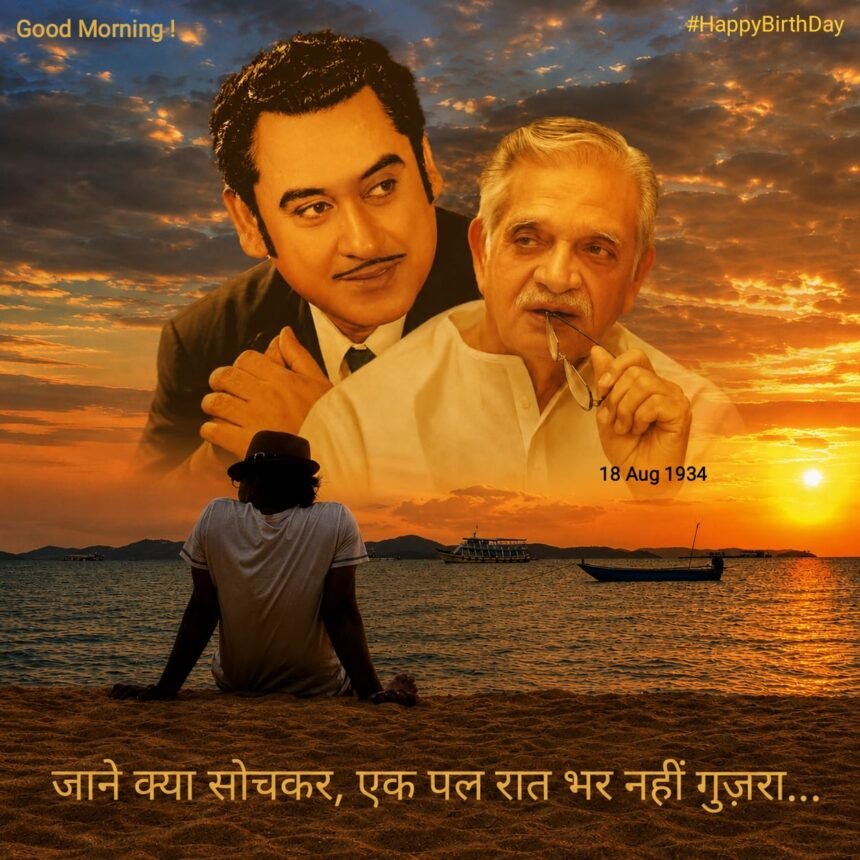
August brings two major figures of Hindi cinema together. August 4 marked the birth anniversary of the inimitable Kishore Kumar, fondly remembered as ‘Guru Thakur (K2)’, while August 18 marks the birthday of the living legend Gulzar. The proximity of their birthdays provides an apt occasion to revisit the extraordinary musical world created when Kishore Kumar’s voice met Gulzar’s verse.
Born Sampooran Singh Kalra in 1934, Dina, Jhelum district, then in undivided India, adopted ‘Gulzar’ as his pen name. He went on to establish himself as a poet, lyricist, author, screenwriter, dialogue writer and filmmaker, with a body of work distinguished by imagery, understatement and sensitivity.
Kishore Kumar, born Abhas Kumar Ganguly in 1929 in Khandwa, was equally multifaceted. Besides becoming one of India’s most celebrated playback singers, he was an actor, composer, filmmaker and producer. His voice could move effortlessly between humour, romance, exuberance, loneliness and introspection.

When these two distinct creative sensibilities converged, Hindi film music acquired some of its most memorable expressions.
An early and enduring example was Woh Shaam Kuchh Ajeeb Thi from Khamoshi. Written by Gulzar, sung by Kishore Kumar and composed by Hemant Kumar, the song captured the lingering impression of an unusual evening through a simple, conversational lyric.

The association reached an especially introspective point with Jaane Kya Sochkar from Kinara. Written by Gulzar, composed by R. D. Burman and sung by Kishore Kumar, the song explores memory, emotional distance and thoughts left unresolved. Kishore’s restrained rendition gives the words the quality of an inner reflection, with pauses and phrasing allowing the silences within the lyric to carry emotional weight.

The same understanding is evident in Musafir Hoon Yaaron from Parichay, where the traveller becomes a metaphor for life’s continuing journey. In O Majhi Re Apna Kinara from Khushboo, Gulzar’s imagery of a boatman and a distant shore becomes a meditation on uncertainty, loneliness and the search for direction. Aanewala Pal Janewala Hai similarly turns the fleeting nature of time into a philosophical reflection.
Koi Hota Jisko Apna, Raah Pe Rehte Hain and Hawaon Pe Likh Do Hawaon Ke Naam further demonstrate the range of their association. Kishore’s distinctive strength was his ability to make Gulzar’s poetry sound lived rather than merely sung.

The meeting was equally effective in romance and relationships. Aap Ki Aankhon Mein Kuch from Ghar, sung by Kishore Kumar and Lata Mangeshkar, transformed an intimate exchange into poetry.
The emotional range became even more pronounced with Aandhi. Its three enduring Kishore Kumar-Lata Mangeshkar duets—Tere Bina Zindagi Se Koi Shikwa, Tum Aa Gaye Ho Noor Aa Gaya and Is Mod Se Jaate Hain—brought together Gulzar’s lyrics and R. D. Burman’s compositions, exploring love, separation, memory and emotional distance without conventional melodrama.
Yet Kishore was only one among the many voices that brought Gulzar’s words alive. With Lata Mangeshkar came Na Jiya Lage Na and Ruke Ruke Se Qadam; with Bhupinder Singh, Ek Akela Is Shehar Mein and Dil Dhoondta Hai; and with Asha Bhosle, Mera Kuchh Samaan and Katra Katra from Ijaazat. Later collaborations with Vishal Bhardwaj and A. R. Rahman demonstrated the adaptability of Gulzar’s poetry across generations.
Both artists were far more than their popular roles. Kishore extended his career across acting, composition and filmmaking, while Gulzar moved from poetry and lyric writing into screenwriting, direction and literature. Their work embraced humour, romance, philosophy and complexity.
The August birthdays of Kishore Kumar and Gulzar provide a natural occasion to revisit this remarkable meeting of voice and verse.
From the early poignancy of Woh Shaam Kuchh Ajeeb Thi to the deeply introspective Jaane Kya Sochkar, and from Musafir Hoon Yaaron and O Majhi Re Apna Kinara to Aanewala Pal Janewala Hai, their work explored memory, loneliness, relationships, journeys and the passage of time.

The three Aandhi duets added another dimension, bringing their creative sensibility into the complex emotional terrain of love, separation and reconciliation.
As Gulzar’s birthday is observed on August 18, the occasion recalls not only Sampooran Singh Kalra, the man behind the celebrated pen name, but also the extraordinary range of his contribution to Indian literature and cinema.
Alongside that celebration comes the August remembrance of Kishore Kumar, the ‘Guru Thakur (K2)’, whose extraordinary voice became one of the most memorable interpreters of Gulzar’s poetry.
The wider Gulzar legacy is immense, embracing many singers, composers, films and literary forms. Yet the Kishore Kumar–Gulzar combination occupies a distinctive place within it. If Gulzar’s verse found remarkable resonance in several voices, Kishore gave it a particularly distinctive blend of conversational warmth, spontaneity and emotional depth.
Their songs remain a compelling example of how poetry and playback singing can complement and elevate each other.
And Jaane Kya Sochkar, the song (the movie Produced & Directed by Gulzar himself) that lends its words to the accompanying image, perhaps captures this meeting most poignantly. Gulzar’s evocative poetry gives shape to an elusive thought, while Kishore Kumar’s restrained and deeply expressive rendition transforms that thought into a palpable emotion. That was the enduring magic of Kishore Kumar and Gulzar: when voice met verse, poetry found a life beyond the written word.(Authored by Asheesh Poddar)