


*By Dr M K Saha
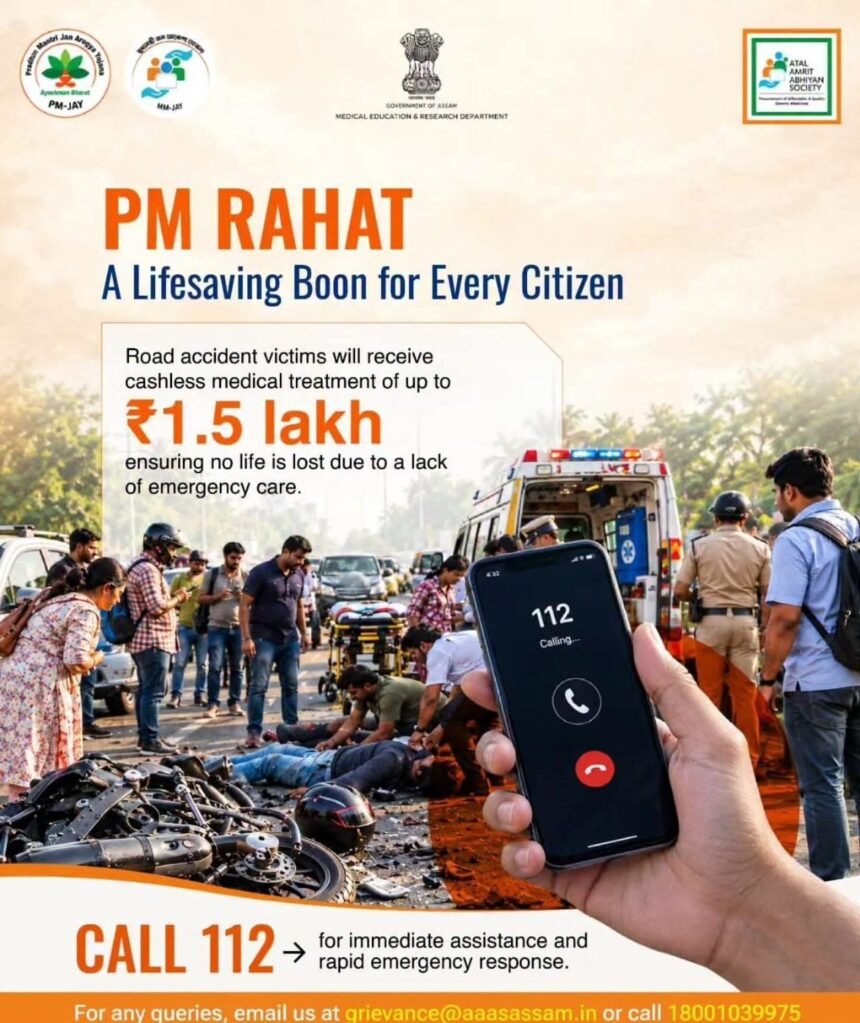
Implementation of the PM RAHAT(Road Accident Hospitalisation And Treatment) scheme is indeed a highly commendable step taken by the Hon’ble Lieutenant Governor of these Islands recently and a welcome relief to the Islanders. In fact, Islanders were anxiously waiting for its implementation in these islands even though the same is already in place in parts of mainland since February 2026.
At a time when an unsuspecting victim falls prey to a rowdy driver it not only becomes a horrendous surprise for the victim but for the family members too, to arrange for an emergency treatment to save the life of the victim, more so, since a delay beyond the conventional ‘Golden Hour’ may prove dearly to the likelihood of survival of the victim, at times, and the financial burden that is imposed on the victim or the family members, particularly those who are from the lower economic status, for getting appropriate management at a well-equipped multispecialty hospital. Therefore, provision of this financial assistance is indeed a welcome reprieve.

Now let us discuss the flip side of this emergency financial assistance scheme for seriously injured Road Traffic Accident (RTA) victims. While the financial assistance is undoubtedly a relief, it must not become a substitute for strict enforcement of traffic laws or indirectly shield reckless drivers from the consequences of their actions. It would be appropriate to explore whether the amount spent by the Government on treating an accident victim could be recovered from the offending driver within a stipulated period, preferably one month, wherever culpability is established, except in cases involving genuine technical failure of the vehicle. Such recovery could serve as a deterrent to habitual offenders who indulge in reckless overtaking and over-speeding, often endangering not only others but their own lives as well.
Although cases are registered following road accidents and the accused drivers are booked after preliminary investigation, the legal process often takes years to reach its conclusion. Bail and prolonged proceedings may embolden habitual offenders, who continue to disregard traffic regulations. The Government should therefore consider an appropriate legal mechanism for expeditious trial of serious RTA cases through Fast Track Courts, with a decision preferably within three months and, at the most, six months. Fixed hearing schedules and strict adherence to deadlines could prevent deliberate delays. Where witnesses fail to appear despite due opportunity, courts may consider proceeding on the basis of available evidence in accordance with law.

A number of practical measures could also help curb road accidents. CCTV cameras should be installed at strategic locations, particularly accident-prone stretches and areas notorious for over-speeding. These cameras should be continuously monitored by responsible police personnel to identify offenders and detect violations. Traffic challans could be issued promptly, with violators required to deposit the penalty within 48 hours, failing which appropriate action, including suspension of the driving licence, may be considered. Video evidence should be made available to those contesting a violation.

Drivers suspected of operating vehicles under the influence of alcohol or narcotic substances should be immediately detained and taken to the nearest hospital for forensic examination. Any delay could affect the detection of intoxicating substances in the blood and consequently weaken the case against the offender.
The feasibility of introducing GPS-based or sensor-enabled speed-control systems in vehicles may also be explored. Such technology could alert authorities whenever a vehicle exceeds permissible speed limits and, where technically and legally feasible, restrict excessive speeds. This could substantially reduce accidents caused by over-speeding. Traffic personnel should also be equipped with video cameras and walkie-talkies to alert police teams at subsequent checkpoints about habitual violators, enabling their immediate interception.
More Read

Two-wheelers and commercial yellow-plated vehicles deserve particular attention, given the frequent complaints of dangerous overtaking and excessive speed. Travel agencies should obtain written undertakings from newly appointed drivers making it clear that reckless driving or driving under the influence of alcohol or drugs could invite dismissal, besides legal and financial consequences. Where negligence is established, recovery of the Government’s expenditure under PM RAHAT could also be explored through an appropriate legal framework.
It is also germane to note that healthcare services under the A&N Administration are provided free of cost, unlike in many parts of mainland India. In this context, the provision of Rs. 1.50 lakh to empanelled government health institutions under PM RAHAT may require a closer examination. The fund could perhaps be earmarked for creating dedicated, adequately equipped units in these institutions to ensure immediate treatment of RTA victims. The possibility of extending assistance to well-equipped private hospitals, whether empanelled or otherwise, should also be explored, particularly when an empanelled facility is not located near the accident site and timely stabilisation is crucial during the Golden Hour.
Unless such preventive and deterrent measures accompany financial assistance, the incidence of road accidents is unlikely to decline. In fact, accidents appear to be increasing at an alarming rate, so much so that the acronym RTA seems to have acquired a new meaning—“Roj Traffic Accidents”—instead of the conventional Road Traffic Accidents. Therefore, it is my fervent appeal to the A & N Administration to peruse the slew of suggestions made for reducing the incidences of RTAs to a minimum and to explore the feasibility of incorporating some, if not all, the normative ideas in order to bring the incidences of RTA to an irreducible minimum.
These suggestions should not be construed as a criticism of this, rather, one of the most sought-after Schemes, implemented recently by the Honorable Lt Governor of A & N Islands, on the contrary it may be viewed as a perspicacious analysis of the scheme wherein the pros and cons of this Scheme has been extensively highlighted with the sole objective of saving innocent lives from the devilish acts of rowdy drivers.(*The author is a Senior Gynecological Surgeon in A & N Islands).