



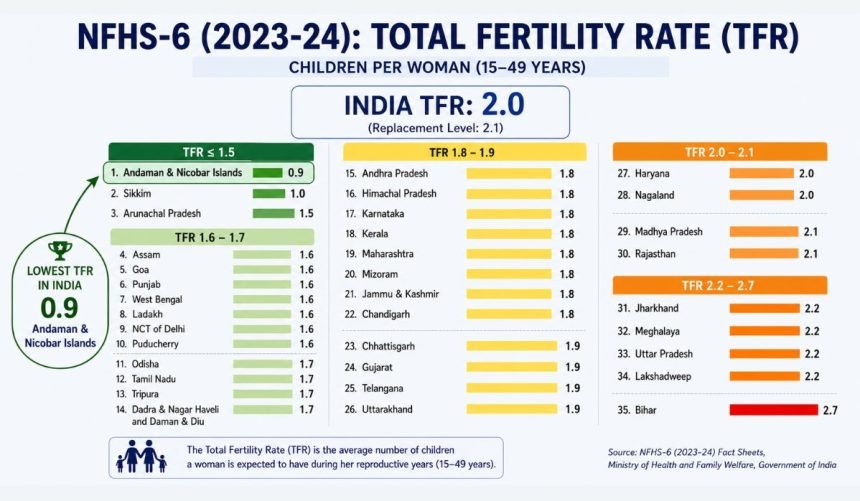
Port Blair: In a demographic milestone that has set the Islands apart from the rest of the country, the Andaman and Nicobar Islands have emerged as India’s lowest-fertility region, becoming the only State or Union Territory where women are, on average, having fewer than one child during their reproductive years. Islands have recorded the lowest Total Fertility Rate (TFR) in the country, according to the National Family Health Survey (NFHS-6) 2023-24 Fact Sheets released by the Ministry of Health and Family Welfare, highlighting a dramatic demographic shift that is likely to have long-term social and economic implications for the Union Territory.
The latest survey places the Islands’ Total Fertility Rate at just 0.9 children per woman, a sharp decline from 1.3 children per woman recorded in NFHS-5 (2019-21). The figure is significantly below the national average of 2.0 children per woman and marks the first time that any State or Union Territory in India has recorded a fertility rate below one child per woman.
The survey further reveals that fertility levels have declined across both urban and rural areas of the Islands, with urban regions recording a TFR of 0.8 and rural areas 0.9, indicating that the trend is widespread rather than confined to specific pockets. The decline represents a reduction of nearly 31 per cent in just a few years, underscoring the rapid pace at which demographic patterns are changing in the Islands. Experts generally regard a fertility rate of around 2.1 children per woman as the replacement level required for a population to maintain its size over time without migration. The Islands’ current figure is less than half that threshold.

Among other States and Union Territories, Sikkim recorded the second-lowest fertility rate at 1.0, while Arunachal Pradesh stood at 1.5. Several regions, including West Bengal, Goa, Punjab, Delhi and Puducherry, reported a TFR of 1.6, while Bihar continued to register the country’s highest fertility rate at 2.7 children per woman.
The findings reflect broader national trends of declining fertility driven by improved access to education, healthcare services, family planning, delayed marriages, greater workforce participation among women and changing socio-economic aspirations. However, the exceptionally low fertility rate in the Andaman and Nicobar Islands has also sparked interest among demographers and policymakers, who may seek to understand the factors contributing to such a steep decline.

While lower fertility is often associated with improvements in maternal health and socio-economic development, sustained ultra-low fertility levels can pose future challenges, including an ageing population, shrinking workforce and increased dependency ratios. These trends could have important implications for long-term planning in areas such as healthcare, education, employment and social welfare.

The NFHS-6 findings, based on data collected during 2023-24, place the Andaman and Nicobar Islands at the extreme lower end of India’s fertility spectrum, making the Union Territory a unique demographic case study and drawing attention to the profound social transformations taking place across the Islands.
As policymakers and researchers analyse the latest data, the Islands’ record-low fertility rate is likely to trigger a wider debate on population dynamics, development priorities and the demographic future of one of India’s most geographically isolated regions.