


By Asheesh Poddar
There are some people who never enter our lives in person, yet somehow become members of our family. To me, Rabindranath Tagore was exactly that—not related by blood, yet one of my closest companions in spirit.
From my earliest childhood, I knew him as an integral part of our home. He was present in the atmosphere of our house, in the pages of books, in framed pictures, in melodies, in my father’s discussions, and in the cultural environment in which I grew up. Never did I feel that he was merely a great poet from history. Instead, he always seemed like a silent yet constant member of our family.

His literary creations—novels, short stories, poems and essays; his portraits, sketches and other works of art—all formed an inseparable part of our everyday life. My introduction to Rabindranath was never a matter of formal education; it was simply a natural part of living and growing up.
My father was an exceptional teacher and a highly learned man. He possessed profound knowledge of Rabindranath’s literature, music, philosophy, education and paintings—indeed, of his entire multidimensional world of creativity. Our home frequently hosted gatherings of my father’s literary-minded friends and colleagues. Rabindranath was invariably the focal point of their discussions. His poetry, songs, plays, novels, philosophy, social thought, and even his paintings would come alive in those conversations. As a little boy, I would quietly listen to them. I understood very little then, yet instinctively felt that there must be something extraordinary about this man who captivated so many minds and hearts.

Many of my father’s friends were passionate admirers of Rabindranath’s songs, popularly known as Rabindra Sangeet. Their wives, too, sang beautifully. Among them, Smt. Tripti Sanyal, whom I affectionately regarded as an elderly aunt, remains unforgettable. Her soulful renditions of Rabindra Sangeet are etched in my memory. Listening to her melodious voice, I gradually began to realise, even as a child, that Rabindra Sangeet was not merely music—it was an emotion, a way of life, and a lifelong spiritual pursuit.

My father was primarily a singer of Bhatiali, the traditional folk songs of Bengal associated with boatmen and rivers. Yet, every now and then, he would sing Rabindranath’s songs as well. I loved listening to Rabindra Sangeet in my father’s voice. Looking back today, I feel that those songs touched me so deeply because they carried not only their inherent beauty but also the warmth, affection and love of my father.
Then one day, a gramophone entered our home, and with it came Rabindranath in an altogether new way. Through the immortal voices of Pankaj Mullick, George Biswas, Hemanta Mukhopadhyay and Suchitra Mitra, Rabindra Sangeet began to fill every corner of our house. Those songs did not merely reach my ears—they slowly found a permanent place in my heart.
More Read

Many years later, as I grew older, I had the joy of listening to Rabindra Sangeet rendered by Kishore Kumar—the singer I had adored throughout my childhood and adolescence. It was an indescribable feeling. It seemed as though my two worlds of love—Rabindranath and Kishore Kumar—had come together in a beautiful union. Out of deep affection, I lovingly call Kishore Kumar my other ‘Thakur’—my ‘Guru Thakur.’ The meeting of my two ‘Thakurs’ (the Gods) remains one of the most precious treasures of my heart. Even today, I find it impossible to express that joy in words.
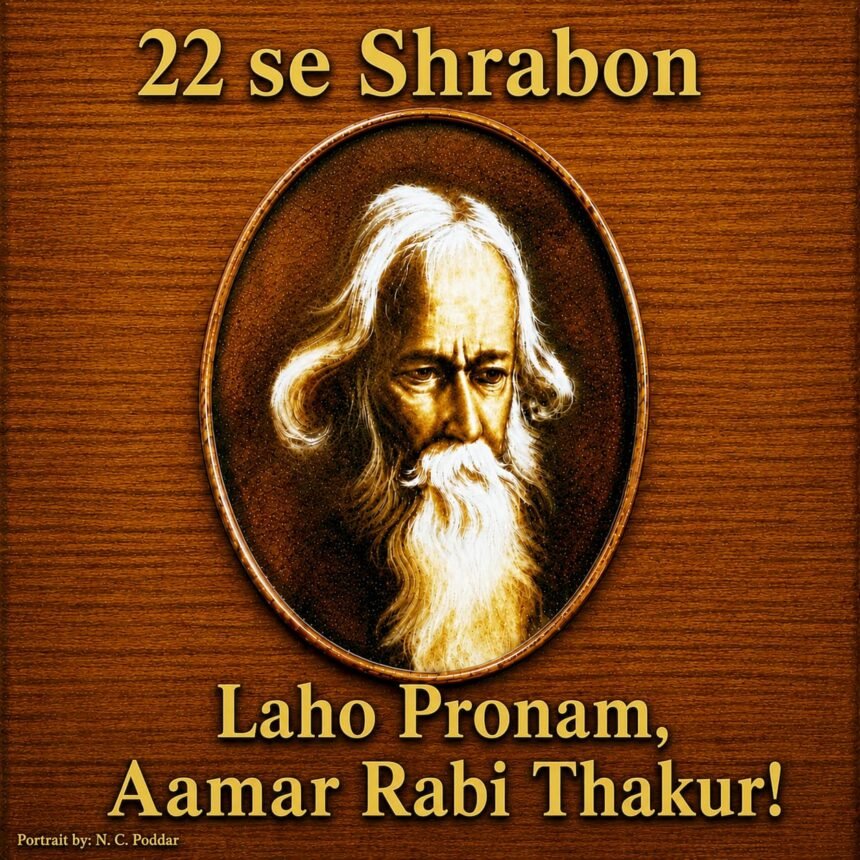
The cultural programmes organised by Atul Smriti Samity, our Bengali Club, also formed an inseparable part of my growing-up years. I was mesmerised by Rabindranath’s songs, poems, recitations and other creations, especially during the annual observances of 25 Boishakh, celebrating his birth anniversary, and 22 Shraban, commemorating the day of his passing. Those programmes were far more than cultural events; they were a beautiful tradition through which Rabindranath’s spirit was lovingly passed from one generation to the next.
Later in life, I had the privilege of performing on that very stage during the commemorative programmes held on both 25 Boishakh and 22 Shraban. The stage that I had once admired with awe and reverence from the audience became the stage on which I eventually performed. That remains one of the most cherished blessings of my life. Even today, memories of that stage, that ambience and those occasions fill my heart with joy.
As I grew older, I realised that Rabindranath was far more than a poet. He was an eternal consciousness, an entire cultural universe. Whether in literature, music, education, painting, philosophy, social thought or humanism, he touched every field with unmatched brilliance. The more I read and listened, the greater my admiration became. I often wondered how one human being could create so much, and in so many different spheres, within a single lifetime.
Every year, as 22 Shraban arrives, my mind travels back to those unforgettable days—the fragrance of books, my father’s discussions on Rabindranath, the literary gatherings at home, the soulful Rabindra Sangeet sung by Mrs. Tripti Sanyal, my father’s voice moving effortlessly between Bhatiali and Rabindra Sangeet, the gramophone playing Pankaj Mullick, George Biswas, Hemanta Mukhopadhyay and Suchitra Mitra, and later, Rabindra Sangeet in the incomparable voice of Kishore Kumar. I also remember the memorable programmes dedicated to Rabindranath on the stage of Atul Smriti Samity. At such moments, I never feel that he belongs to a distant era. Rather, he seems inseparably woven into my childhood, my adolescence, my journey through life, and the person I have become today.
Today I realise that the foundations of my values, aesthetic sensibilities, and my love for literature and music were laid in that very environment. To me, Rabindranath is not merely a Nobel Laureate or a world poet. He is the foundation of my culture, the language of my emotions, the light that illuminates my mind, and an inseparable companion throughout my life.

On this sacred remembrance of his passing, my heart fills with profound reverence, gratitude and boundless love.
With my deepest reverence and endless love, my beloved Rabi Thakur!