



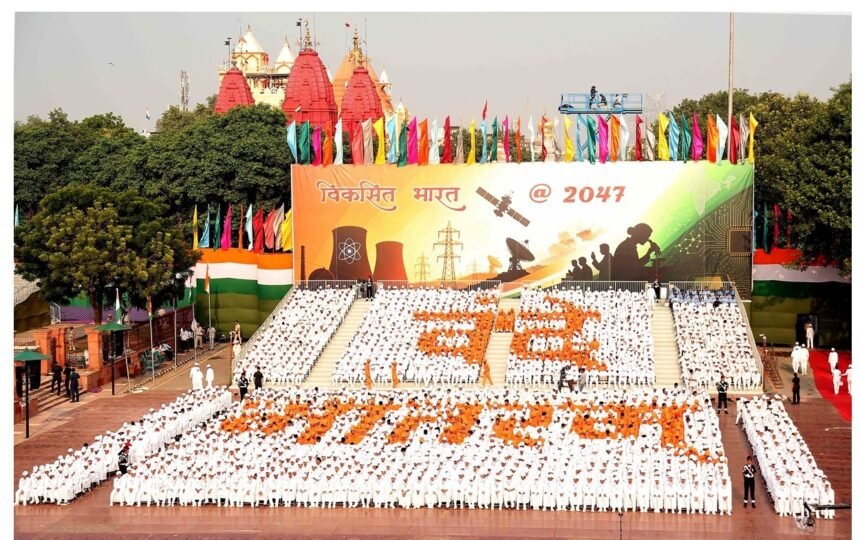
As we Indians prepare to celebrate the country’s 80th Independence Day, one phrase is set to reverberate once again across the country: “Vande Mataram.” What began as a literary composition nearly 150 years ago grew into a powerful anthem of the freedom movement—turning words into a weapon of political resistance.
The song was written by Bankim Chandra Chattopadhyay, one of 19th-century Bengal’s most influential literary figures. Government records marking the 150th anniversary of Vande Mataram cite November 7, 1875, as the date of its first publication in Bangadarshan, the literary journal founded by Bankim. It was later incorporated into his celebrated 1882 novel Anandamath.
Bankim Babu, who was also a British-era civil servant, died in 1894—more than five decades before India achieved Independence in 1947. Yet his words outlived him, becoming part of the emotional language of India’s nationalist struggle.

A salutation to the motherland
“Vande Mataram” broadly means “I bow to the Mother” or “I salute the Mother.” The mother is the motherland, portrayed through images of flowing water, abundant harvests, cool fragrant breezes and lush green fields.

The opening lines—“Sujalam, Suphalam, Malayaja Shitalam, Shasya Shyamalam”—evoke an India that is fertile, beautiful and nurturing.

That imagery gave the composition an emotional force far beyond an ordinary patriotic song. India was imagined not merely as territory, but as a mother deserving love, reverence and sacrifice.
From literature to the freedom struggle
More Read

Its transformation into a political rallying cry gathered pace at the turn of the 20th century.
In 1896, Rabindranath Tagore sang Vande Mataram at the Indian National Congress session in Calcutta, giving it a prominent national platform. The song acquired even greater political significance after the Partition of Bengal in 1905. During the Swadeshi and anti-Partition movement, protesters shouted “Vande Mataram” while boycotting British goods and promoting indigenous products.
The colonial government recognised the song’s growing influence. In 1906, authorities at Barisal attempted to prohibit its public chanting. By then, Vande Mataram was no longer simply a poem. It had become an act of defiance. Sri Aurobindo wrote extensively about the song, while revolutionary groups adopted it as a slogan. Its resonance also extended to the Indian National Army, which used a marching version during its mobilisation efforts.
National Anthem or National Song?
Despite its enormous historical significance, Vande Mataram is not India’s National Anthem. “Jana Gana Mana” is the National Anthem, while “Vande Mataram” holds the status of India’s National Song.
Nearly 150 years after Bankim Chandra Chattopadhyay first put those words on paper, their power remains unmistakable. Every Independence Day, when “Vande Mataram” rises from public gatherings, schools and institutions, it carries with it more than patriotism—it carries the memory of a time when simply uttering