



*By Dr M K Saha
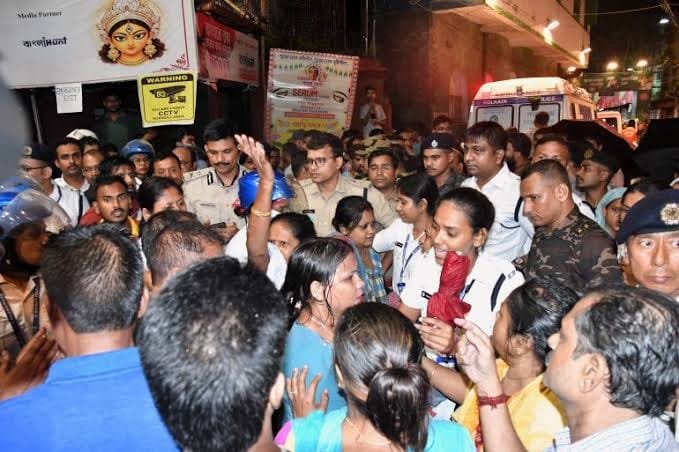
I am as much anguished as everyone else following the dreadful tragedy at the Chorbagan Puja pandal in Kolkata recently, which has claimed as many as 19 lives so far, for no fault of their own. I have not been able to come to terms with the magnitude of the tragedy that struck innocent devotees who had gathered to celebrate a festival rooted in faith, devotion and community spirit. I have no element of doubt that such an egregious tragedy could have been avoided had the organisers taken even the minimum precautionary measures to ensure sufficiently wide entry and exit points, allowing devotees to move in and out safely in the unlikely event of an emergency.
Had these basic safety measures been put in place, this flagrant disregard for the safety of human lives could perhaps have been prevented. But alas! Who cares for innocent lives when everything else takes centre stage in the pursuit of political brownie points? The mere deployment of a huge number of security personnel does not, by itself, guarantee the safety of devotees, particularly when an enormous footfall is anticipated. Inadequate exit routes, bottlenecks, poor crowd-flow management and the absence of a clearly defined emergency evacuation plan can turn a religious gathering into a death trap within minutes.

A sudden, unexpected announcement or an abrupt change in crowd movement can trigger panic and a stampede-like situation, as reportedly happened in this instance. Security arrangements must, therefore, go far beyond the visible presence of police personnel and volunteers; they must be backed by proper planning, adequate infrastructure, coordinated supervision and strict enforcement of safety norms.
What makes such tragedies even more distressing is that they are not necessarily the result of unforeseen circumstances beyond human control. In many cases, the warning signs are evident well before a gathering reaches its peak. The anticipated number of visitors, the carrying capacity of the venue, the width and accessibility of entry and exit routes, the availability of emergency passages, fire-safety arrangements and the preparedness of medical and rescue teams are all matters that can—and must—be assessed in advance. A temporary puja pandal may be erected for a few days, but the responsibility for the lives of thousands of visitors cannot be treated as temporary or casual.

In order to prevent such criminal negligence and loss of innocent lives in the future, I strongly feel that a specific provision should be incorporated into the Bharatiya Nyaya Sanhita (BNS) to deal with deaths caused by gross negligence or reckless disregard for public safety at mass gatherings. A provision along the lines of “Culpable homicide ‘amounting’ to murder”, as suggested here in a broader sense, could be considered by the competent authorities, subject to careful legal scrutiny and appropriate drafting. The objective should be to ensure that organisers, contractors or other persons entrusted with safety responsibilities cannot escape accountability when their wilful disregard of mandatory precautions results in fatalities.

Such a provision must, of course, distinguish between a genuine accident despite reasonable precautions and a tragedy arising from gross negligence, conscious disregard of danger or deliberate violation of safety requirements. Criminal liability must be determined on the basis of evidence, the degree of negligence and the applicable law. However, where culpable conduct is established, the consequences must be sufficiently stringent to reflect the gravity of the offence. Besides appropriate imprisonment and substantial financial penalties, the law should provide for accountability of those responsible for approving, inspecting and supervising the event wherever their own culpable conduct is established.
Equally important is the need to make comprehensive safety audits mandatory for large religious gatherings, festival pandals and other public events expected to attract massive crowds. Organisers should be required to demonstrate that the venue has adequate entry and exit points, unobstructed emergency routes, effective crowd-control arrangements, fire-safety equipment, public-address systems and readily accessible medical assistance. Crowd capacity should be determined scientifically, rather than by the organisers’ enthusiasm to accommodate ever-increasing numbers of devotees. Surprise inspections and strict compliance checks should be conducted before permission is granted and, where necessary, during the event itself.

Ultimately, the purpose of any such legislation should not be merely to punish after a tragedy has occurred, but to create a credible deterrent against negligence and compel organisers to place human life above prestige, publicity and political considerations. No religious celebration, however grand or popular, can justify compromising the safety of those who attend it in good faith.
Festivals are meant to bring people together in devotion, happiness and celebration—not to leave families grieving over the preventable loss of their loved ones. The 19 lives reportedly lost in the Chorbagan tragedy must not become just another statistic that fades from public memory after a few days of outrage. Their deaths should serve as a wake-up call for the authorities, organisers and policymakers to ensure that no devotee is ever again forced to pay with their life for another’s negligence.
Human life must take precedence over every other consideration. If the law is to mean anything, those entrusted with public safety must know that negligence resulting in the loss of innocent lives will invite consequences commensurate with the gravity of their conduct.*(The author is a Senior Medical Specialist)