



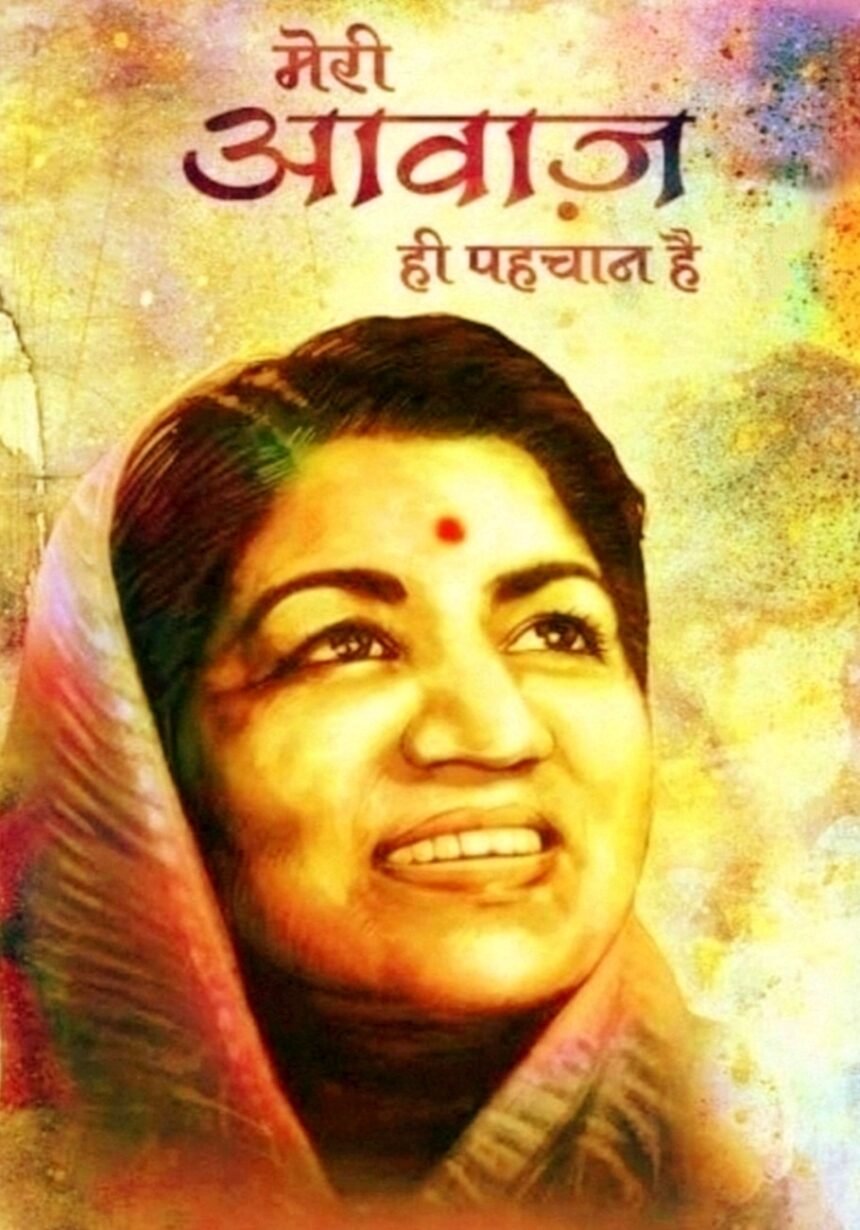
On her 97th birth anniversary on 28th September, a closer look at the lesser-known dimension of Lata Mangeshkar’s legacy—the singer who took her voice beyond the recording studio to question the anonymity, unequal recognition and limited rights of playback artistes.
A voice could become the soul of a film, travel across generations and find a permanent place in the collective memory of millions. Yet, for much of the early Hindi film industry, the person behind that voice often remained outside the frame. The singer’s contribution was heard everywhere, but the singer’s identity was not always acknowledged with the same prominence.
Lata Mangeshkar’s journey was, therefore, about more than becoming the most recognisable voice of Indian cinema. At a time when playback singers could be heard everywhere but were not always named with equal prominence, she began asserting a simple but consequential principle: the voice belonged to a person, and that person deserved to be identified.

The issue acquired wider resonance with Aayega Aanewala, from Mahal (1949). The record initially identified the song with the character Kamini rather than the singer. But listeners wanted to know who was behind that extraordinary voice. Their curiosity helped bring the question of credit for playback singers into public focus.
For Mangeshkar, a singer’s name was not a decorative addition to a record sleeve or film credit. It represented recognition of the artiste whose performance could become inseparable from a film’s emotional identity. Her position questioned an industry hierarchy in which the actor’s face was visible to the audience while the singer behind the voice could remain invisible.

But the struggle for recognition did not end with a name.

There was also the question of what happened to the economic value of a performance after the recording session was over. Playback singers were often paid a one-time fee even though their recordings could continue to circulate and generate commercial value. Mangeshkar advocated royalty payments, bringing the economic rights of singers into a larger professional debate.
At its heart was a straightforward distinction: payment for making a recording and the continuing commercial use of that recording were not necessarily the same thing. The issue extended beyond the remuneration of one celebrated singer. It raised the larger question of whether playback artistes, whose performances were central to the film-music industry, should have a continuing stake in the value created by their work.
More Read

The debate over royalties and performers’ rights continued for decades, involving artistes, industry stakeholders and legal advocates. The Copyright (Amendment) Act, 2012, subsequently introduced significant changes to India’s copyright framework, including provisions relating to performers’ rights and royalties. Mangeshkar’s advocacy formed part of this wider history of the struggle for professional recognition and rights.
There was, therefore, another dimension to her legacy. She was not merely a singer who achieved extraordinary professional stature; she was an artiste who used that stature to raise questions affecting an entire community of performers. Her insistence on recognition and fair treatment gave a public voice to concerns that extended beyond the recording studio.
And yet, all of this unfolded against the backdrop of a musical legacy that requires little introduction. Her repertoire crossed genres, generations and linguistic boundaries. Her recordings travelled far beyond the geography of Indian cinema, becoming part of the memories and lives of millions. The Bharat Ratna, conferred in 2001, recognised an artistic contribution deeply embedded in India’s cultural life.
Yet, the significance of Lata Mangeshkar’s journey lies not only in the extraordinary reach of her singing. It also lies in the professional questions she helped bring into the open: the identity of the voice behind a performance, the value of that contribution and the rights of the artiste whose work continued to live long after the microphone was switched off.
‘MERI AWAAZ HI PEHCHAN HAI’ is remembered as a statement of artistic identity—a voice becoming the singer’s enduring signature. But viewed from another perspective, it carries a wider meaning: the insistence that a voice must not be separated from the person who created it, and that recognition must extend beyond applause.
On her 97th birth anniversary, the story of Lata Mangeshkar invites us to listen not only to the voice that touched millions around the globe, but also to the voice that spoke up for the dignity, recognition and rights of those who made playback singing a profession.(The piece is authored by Asheesh Poddar)