



By Asheesh Poddar
Today, there is an unusual silence in the Indian musical calendar. 8 September, the birth anniversary of Asha Bhosle, arrived this year without the woman whose voice seemed incapable of ageing. She passed away on 12 April 2026, aged 92, bringing the curtain down on an extraordinary eight-decade musical journey. Yet calling it an ‘end’ seems strangely inappropriate. Asha Bhosle’s music has always defied endings.
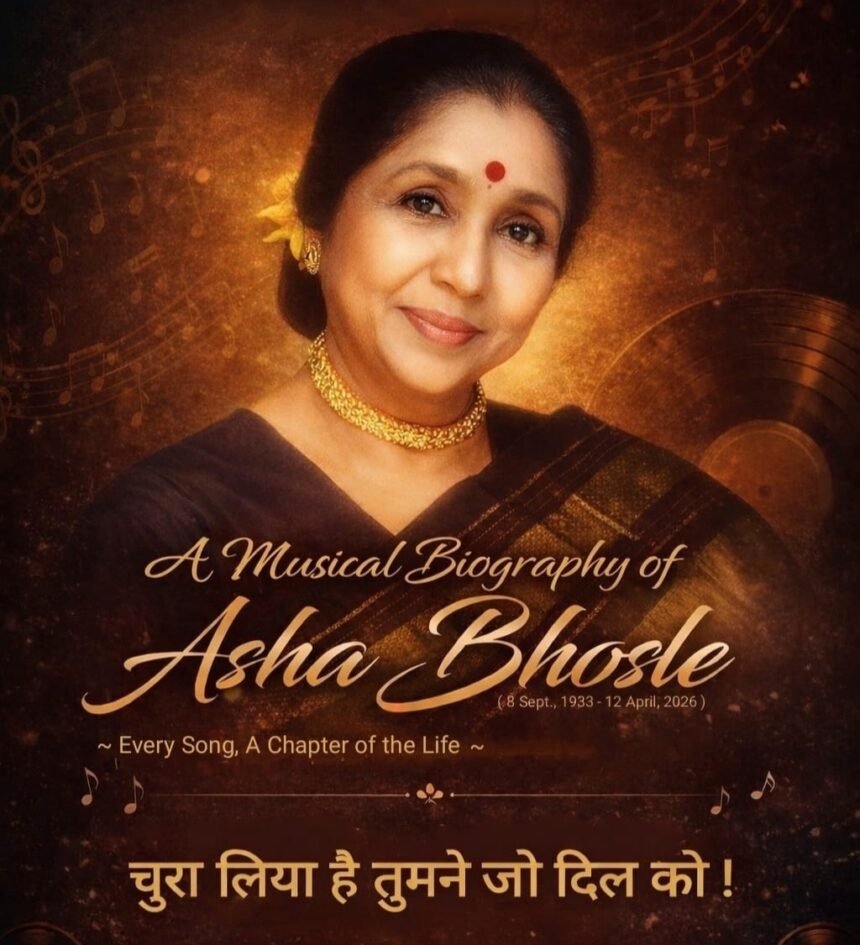
Perhaps the better question on her 93rd birth anniversary is not how many songs did Asha Bhosle sing? but what did that voice do to us? It charmed, teased, seduced, comforted, surprised and, somewhere along the way, chura liya—stole something from every listener: a moment, a memory, an emotion. In that sense, ‘Chura Liya…!’ becomes more than a familiar expression from a popular song; it becomes a fitting complement to a voice that quietly stole the hearts of generations.
But Asha’s journey to becoming that unmistakable voice was not straightforward. Lata Mangeshkar’s towering dominance of female playback singing had already occupied much of the mainstream musical landscape. For Asha, simply attempting to enter the same space was never going to be easy. She had to look elsewhere, and that necessity gradually became an artistic advantage. She moved towards lighter music, rhythm-driven numbers, folk, cabaret, sensuality, playfulness and experimentation—territories that eventually allowed her to create an identity entirely her own.

O. P. Nayyar recognised that distinctive possibility, while her celebrated association with R. D. Burman opened another extraordinary chapter. Their partnership was a meeting of two restless musical minds—fearless, contemporary and unwilling to remain confined by convention. Asha did not merely sing those unconventional compositions; she gave them attitude, personality and life. Yet her story did not end with any one composer. She continued crossing genres, languages and generations, proving repeatedly that curiosity was more powerful than age.
That is perhaps the real secret of Asha Bhosle. She never allowed yesterday’s success to dictate tomorrow’s music. What began as a search for her own space became an unparalleled musical identity. Her greatness was not simply in the number of songs she recorded, but in the astonishing number of worlds she could inhabit through her voice. And this is what makes the phrase ‘A Musical Biography of Asha Bhosle—Every Song, A Chapter of the Life’ so much more than it says. Her songs were indeed chapters—each revealing another shade of the woman and the artist.

And then the voice fell silent. But Indian music has not really lost Asha Bhosle; it has lost only the possibility of hearing what she might have done next. Her songs remain chapters of a life lived through music—chapters of struggle, reinvention, romance, mischief, sensuality, celebration and sheer musical adventure.

So, on her 93rd birth anniversary, perhaps the most fitting tribute is not an obituary. Play an Asha Bhosle song. Then play another that sounds completely different. Somewhere between those two voices lies the story of the woman who refused to be defined by one voice.
She came, she sang—and somewhere along the way, she just stole our hearts forever, with Asha Bhosle – Still Playing!