


Port Blair(Sri Vijaya Puram): For a patient in a remote Island of the Andaman and Nicobar archipelago, reaching Sri Vijaya Puram for urgent specialised treatment can mean more than overcoming distance—it can mean finding money for an air ticket that many families simply cannot afford. The question now is whether medically referred patients from remote Islands should again be provided free helicopter transportation when timely treatment is not available locally.
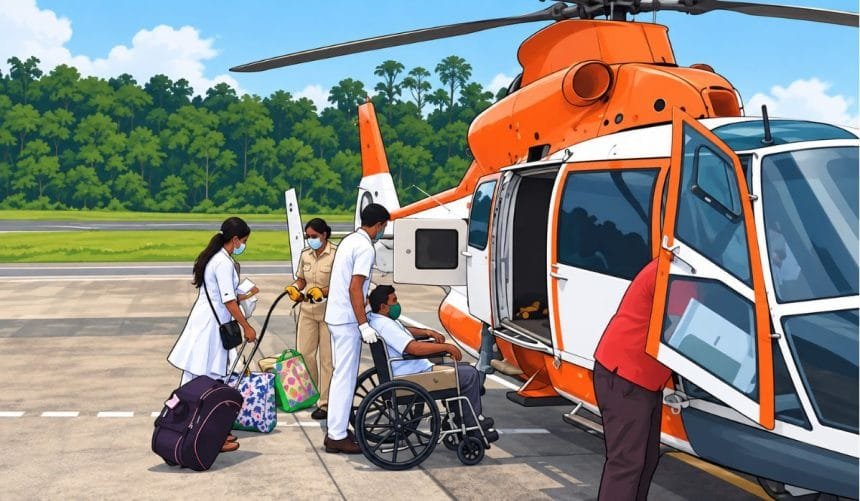
There was a time when patients from remote Islands requiring advanced treatment, surgery or specialised care that could not be delayed were referred by doctors to Sri Vijaya Puram and transported free of cost by helicopter or IAF Dornier services. The facility proved particularly valuable for residents of the Nicobar Group, where even subsidised airfares can be beyond the reach of ordinary families.
Under the earlier system, when a government doctor considered a patient’s condition serious enough to warrant immediate transfer, the patient was transported by air along with one attendant without payment. The arrangement was subsequently modified, with free transportation restricted to the patient while the attendant was required to pay the applicable fare. Eventually, the facility was withdrawn for general patients, though tribal patients continued to receive free transportation.

At present, free air transportation for medically referred patients is understood to be available only to Particularly Vulnerable Tribal Groups (PVTGs), with the cost borne by the concerned department. For others, air travel is chargeable unless the case qualifies for emergency evacuation.
This distinction is significant. Emergency evacuation is available when a patient is in a life-threatening condition and immediate evacuation is necessary, particularly when no scheduled air connectivity is available within the required timeframe. But not every patient requiring urgent specialised treatment necessarily falls within that category.
This leaves a critical gap for patients who need to reach the Islands’ only tertiary-care hospital, G.B. Pant Hospital at Sri Vijaya Puram, without necessarily being in a situation warranting emergency evacuation.

The financial burden can be particularly severe for residents of far-flung Islands. A patient travelling from Campbell Bay on a medical referral by air reportedly has to pay ₹5,350. With one attendant—often indispensable for a sick or vulnerable patient—the airfare rises to ₹10,700. For a low-income household, this can represent a substantial share of monthly earnings even before accommodation, food, local transport and other expenses in Sri Vijaya Puram are taken into account.
The concern is not merely about affordability. The inability to meet the cost of air travel can result in patients postponing treatment that doctors have already considered necessary. In a geographically dispersed Union Territory where several Islands lack the specialised medical facilities available at G.B. Pant Hospital, delay can have serious consequences.
More Read

Patients whose condition does not require immediate intervention can continue to be referred by ship, as is the established practice. But for those who require timely access to tertiary care, waiting for sea transportation may not always be medically appropriate. The issue, therefore, merits a policy review rather than being viewed simply as a question of subsidised travel.
A possible approach could be to restore free or substantially subsidised helicopter transportation for patients medically certified by government doctors as requiring time-sensitive specialised treatment, with appropriate safeguards against misuse. The existing emergency evacuation mechanism could continue for life-threatening cases, while medically urgent referrals that fall outside the emergency category could be covered under a separate referral-based system.
For residents of remote Islands, air connectivity in such circumstances is not a matter of convenience or luxury. Geography itself creates a healthcare disadvantage that does not exist to the same extent on the mainland. When the required treatment is available only in Sri Vijaya Puram and there is no road or immediate alternative means of reaching it, the cost of reaching the hospital can become an additional barrier to healthcare.
The Andaman and Nicobar Islands require solutions suited to their unique geography. For a medically referred patient in a remote Island, timely air transportation should be seen not as a privilege, but as an essential link between the patient and the treatment that may be available hundreds of kilometres away.